Local citations: what they are and how to build them
Updated
A local citation is any online mention of a business’s name, address and phone number (NAP), usually on a directory such as Yelp, Apple Maps or Bing Places. Consistent citations help customers find the business and help search engines trust that its details are correct.
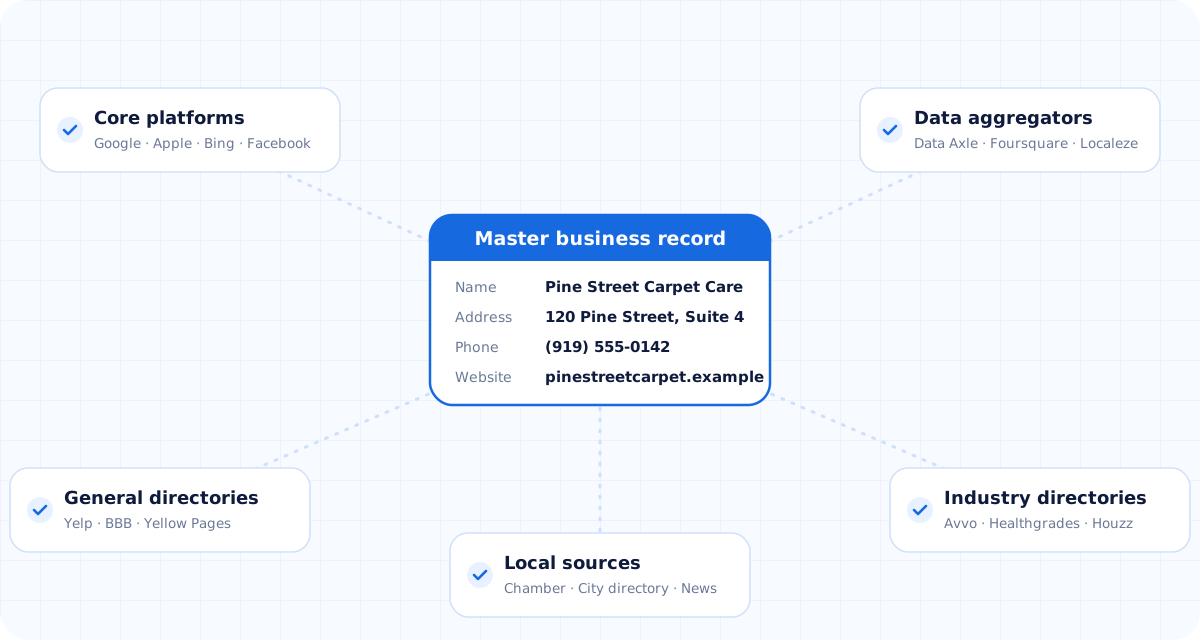
What counts as a local citation?
A citation is any place online that lists a business’s core details. The minimum is the name, address and phone number. Most directory listings also carry the website, categories, opening hours, photos and a description.
Citations come in two forms:
- Structured citations sit in a directory’s fixed fields: a Yelp profile, an Apple Maps place card, a Better Business Bureau listing. These are what most people mean by “citations”, and they are what you build.
- Unstructured citations are mentions in ordinary text, such as a local news story, a sponsor list or a blog post that names the business and its address. You earn these rather than submit them.
The five types of citation sources
| Type | Examples | Why it matters |
|---|---|---|
| Core platforms | Google Business Profile, Apple Business Connect, Bing Places, Facebook | Where most local searches happen. Fix these first. |
| Data aggregators | Data Axle, Foursquare, Localeze | Feed business data to hundreds of apps, maps and smaller directories. |
| General directories | Yelp, Yellow Pages, BBB, Manta | High-traffic sites that customers and search engines both read. |
| Industry directories | Avvo (legal), Healthgrades (medical), Houzz and Angi (home services) | Relevance: they show the business belongs to its category. |
| Local sources | Chamber of commerce, city business directory, local news | Tie the business to its town or region. |
Why local citations matter for local SEO
Google says local results are based mainly on three things: relevance, distance and prominence. On prominence, Google’s own help page says it is “based on information that Google has about a business, from across the web, like links, articles, and directories.” Directory listings are part of that picture.
Citations help in three practical ways:
- Trust in the data. When the same name, address and phone number appear across many independent sources, the details are more likely to be correct.
- Customer discovery. People search Yelp, Apple Maps and industry sites directly. A missing or wrong listing loses calls.
- Category relevance. Industry directories confirm what the business does, not only where it is.
Citations are not a ranking shortcut on their own. They work alongside a complete Google Business Profile, reviews, a relevant website and, for agencies, supporting content such as cloud stacking pages.
NAP consistency: get one master record first
Before you submit anything, write down one master record and use it everywhere. Small differences add up: an old suite number, a call-tracking number or “St.” on one site and “Street” on another.
| Field | Consistent | Inconsistent |
|---|---|---|
| Name | Pine Street Carpet Care | Pine St Carpet Care – Best Carpet Cleaning Raleigh |
| Address | 120 Pine Street, Suite 4, Raleigh, NC 27601 | 120 Pine St #4 (one site) and an old address (another) |
| Phone | One main local number | Different call-tracking numbers on each site |
| Website | The same canonical URL | http, www and a landing page mixed |
Keep the business name exactly as it appears on signage and legal documents. Adding keywords to the name breaks Google’s Business Profile guidelines and can get a profile suspended.
How to build local citations, step by step
- Lock the master record. Name, address, phone, website, primary category, hours, a short and a long description, logo and photos.
- Audit what already exists. Find current listings, wrong details and duplicates before you create anything new. A free citation audit does this in minutes.
- Fix the core platforms. Google Business Profile, Apple Business Connect, Bing Places and Facebook.
- Submit to the data aggregators. They spread correct data to the long tail of smaller sites.
- Build the top general directories. Yelp, BBB, Yellow Pages and similar.
- Add industry and local sources. These carry the most relevance for the category and town.
- Record every live URL and re-check. Note which listings went live, which are pending and which need verification, then re-check them on a schedule.
Common citation mistakes
- Leaving duplicates live. Two listings for one location split reviews and confuse customers. Merge or remove them.
- Old addresses after a move. Update the core platforms and aggregators first, then the directories that copy from them.
- Tracking numbers as the main phone. Use the main local number in the phone field; tracking numbers belong in analytics, not in NAP.
- Showing a home address. Service-area businesses can hide their address on Google and should do the same elsewhere where the directory allows it.
- Build and forget. Directories change data over time. A listing that was right last year may not be right today.
How many citations does a business need?
There is no fixed number. Accuracy on the core platforms and the best directories for the industry matters far more than a large count of low-quality sites. A useful benchmark is to look at the businesses already ranking in the Map Pack for your category and town, and make sure you are listed everywhere they are.
Frequently asked questions
What is a local citation?
A local citation is any online mention of a business’s name, address and phone number, most often in a directory listing such as Yelp, Apple Maps, Bing Places or an industry directory.
Do citations still help local SEO in 2026?
Yes, as part of a wider plan. Google says prominence is based on information from across the web, including directories. Accurate citations support trust in the business data, but they work alongside the Google Business Profile, reviews and the website rather than replacing them.
What is NAP consistency?
NAP consistency means the business name, address and phone number are written the same way on every site. Inconsistent details, such as old addresses or different phone numbers, make it harder for customers and search engines to trust the data.
How long do citations take to go live?
It depends on the directory. Some publish within days, others need verification by phone or postcard, and a few take several weeks. Track each listing’s status rather than assuming it is live.