Cloud stacking backlinks: do they pass value?
Updated
Cloud stacking backlinks can pass value when the page they sit on is indexed, useful and relevant, and when the link points straight at the business. They pass little or nothing when the page is thin, never indexed or buried in a chain of other low-value pages.
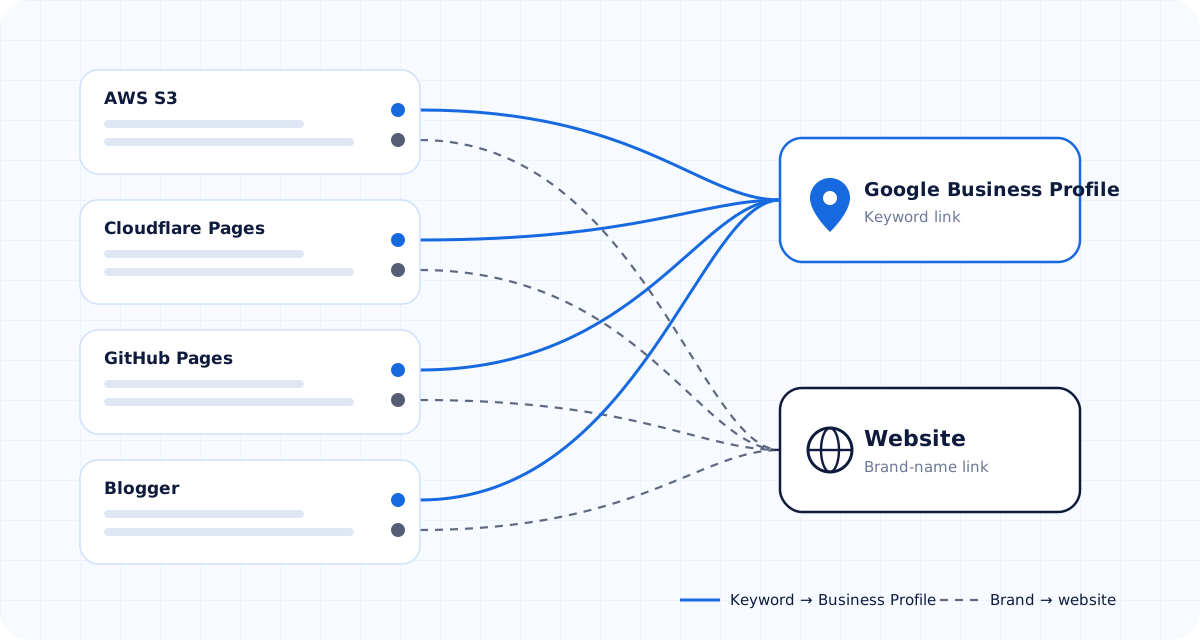
What is a cloud stacking backlink?
A cloud stacking backlink is a link from an article published on a cloud platform (such as AWS, Azure, Google Cloud Storage, GitHub Pages or Cloudflare Pages) to a local business’s website or Google Business Profile. The idea is that the article lives on a well-known domain and adds relevant, consistent information about the business.
How Google treats these links
Google uses links to discover pages and as one of many signals about them. Its documentation says links help it find pages and understand them. It also has clear spam policies: links created mainly to manipulate rankings, including keyword-stuffed links at scale, can be ignored or penalised.
Two practical consequences follow:
- An unindexed page passes nothing. If Google never crawls or indexes the article, its links do not exist as far as Google is concerned.
- The domain alone is not the value. A page on a big cloud domain is still judged as a page. Thin, copied or spun text on amazonaws.com is still thin text.
What makes a cloud stacking link count
| Factor | Passes value | Passes little or none |
|---|---|---|
| Content | Original article with local detail a reader can use | Spun or templated text, keyword lists |
| Indexing | Page is indexed and stays live | Never crawled, or removed after a week |
| Relevance | Topic matches the business and service | Unrelated topic with a link dropped in |
| Link target | Points straight to the GBP or website | Points to another cloud page in a long chain |
| Anchor text | One natural keyword link plus the brand | Many exact-match anchors on one page |
Direct links vs tier chains
Older cloud stacking setups built tiers: Tier 2 pages linked to Tier 1 pages, which linked to an “anchor” article, which finally linked to the business. Every extra hop is another page that must be crawled and indexed before anything reaches the client.
CloudStackly now defaults to direct linking: every page links straight to the client. The default pattern, “Map + Website”, uses one keyword link to the Google Business Profile and one brand-name link to the website. Agencies can still pick another pattern per client. The tiered link building guide explains the older structure.
How to link cloud stacking pages safely
- Write one original article per platform. Never publish the same text twice.
- Keep links few: one keyword link and one brand link is enough.
- Vary the article topics around the service, not only the exact keyword.
- Use the business’s real facts: services, areas, hours, how to book.
- Check each page is live and indexable, then check whether Google has indexed it.
- Follow each platform’s terms of service.
What cloud stacking links will not do
They are not editorial links from respected local sites, news outlets or industry associations, and they do not replace a strong Google Business Profile, reviews and accurate citations. Treat them as one supporting layer in a local SEO plan, not the whole plan.
How to measure whether they helped
- Record a baseline before publishing: a geo-grid scan for the keyword and Search Console data for the target page.
- Publish, verify every live URL and track which pages Google indexes.
- Re-scan at 30, 60 and 90 days and compare. Note any other SEO work done in the same period, so you do not credit the links for everything.
Frequently asked questions
Do cloud stacking backlinks work?
They can add value when the pages are original, indexed and relevant, and link directly to the business. They add little when pages are thin, unindexed or part of long chains of low-value pages.
Are cloud stacking backlinks dofollow?
Most cloud hosting platforms let you publish your own HTML, so links are followed unless you add rel="nofollow". Blogging platforms may set their own rules, so check each published page.
Are cloud stacking backlinks safe?
The risk depends on how they are built. Google’s spam policies target links made mainly to manipulate rankings, especially keyword-stuffed links at scale. Few links per page, original content and real business facts keep the risk low.
How many cloud stacking links should I build?
There is no set number. A campaign of one original article on each of 10–20 different platforms, each linking once to the Business Profile and once to the website, is a common, measurable starting point.