Case study: an Austin law firm’s Map Pack visibility after one Cloud Link article
Updated
A business and intellectual property law firm in downtown Austin, Texas published one Cloud Link article on AWS on 5 October 2026. We compared Google Maps geo-grid scans taken 14 days before and 16 days after. Two keywords improved sharply and one fell. Here are the before and after maps, the numbers, and what we would and would not conclude from them.
The client
The client is a small business law firm in downtown Austin with a verified Google Business Profile. Its practice areas are business, corporate, intellectual property, entertainment and energy law. We have not published the firm’s name, so the screenshots below have the business name, address and agency branding removed. Everything else is exactly as the rank tracker recorded it.
The starting point
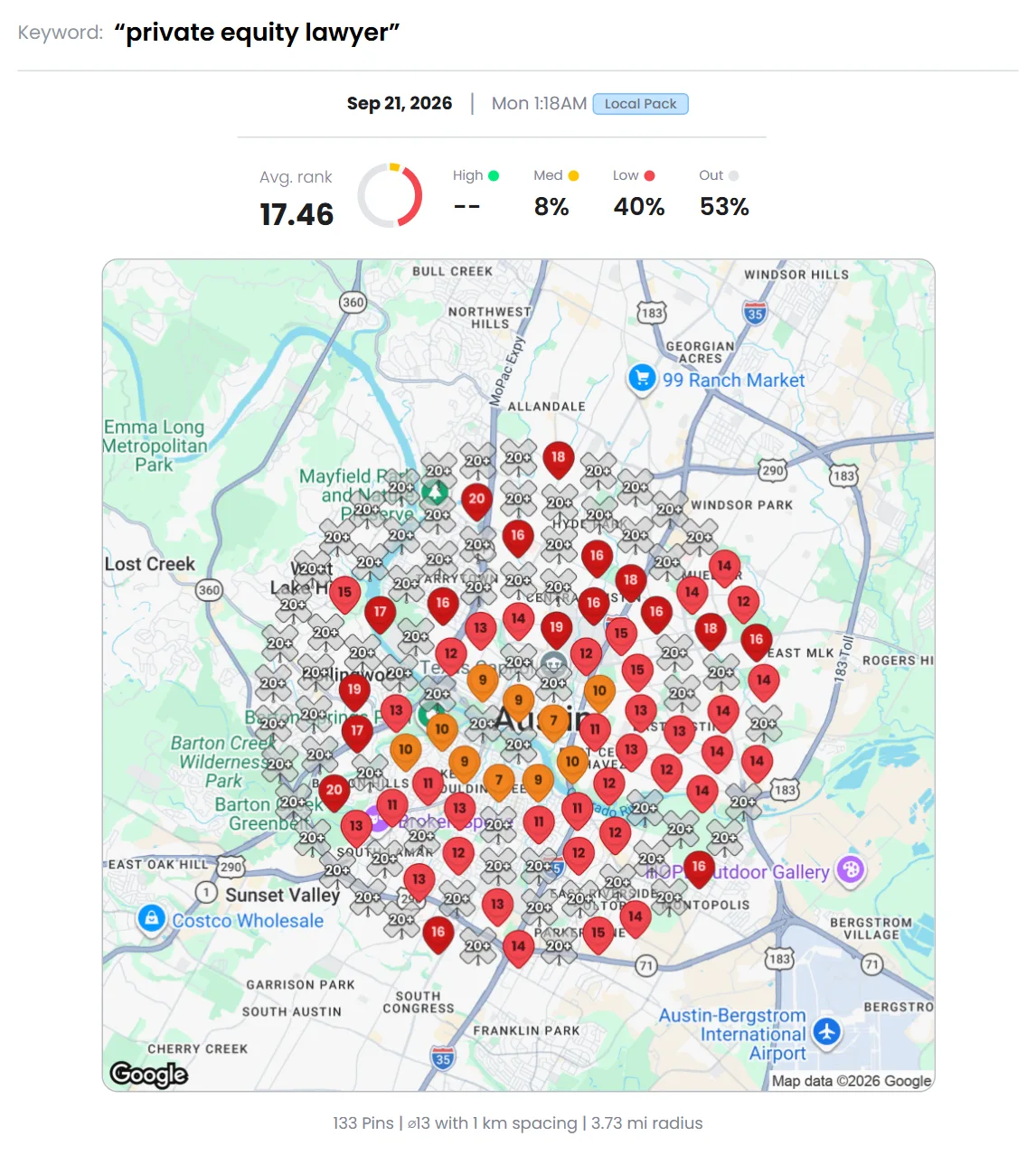
Law firm searches in central Austin are crowded: dozens of firms compete for the same three Map Pack places. In the before scans the firm was invisible across much of its own city. For “private equity lawyer” it did not appear in Google’s top 20 at 70 of 133 grid points, and it reached the top 10 at only 10 points, all close to its office.
What was published
One Cloud Link campaign was published for the firm in CloudStackly. It was a single AWS-hosted source article:
- Published: 5 October 2026, on Amazon S3, and still live.
- Content: 1,491 words about the firm’s legal services for businesses and creators, written for its practice areas and the cities it serves.
- Links: one contextual link to the firm’s website, plus an embedded Google Map of the office.
No other Cloud Link campaigns were published for this firm during the measurement window. A second campaign was created on 19 October but had not been published by the after scan.
How we measured
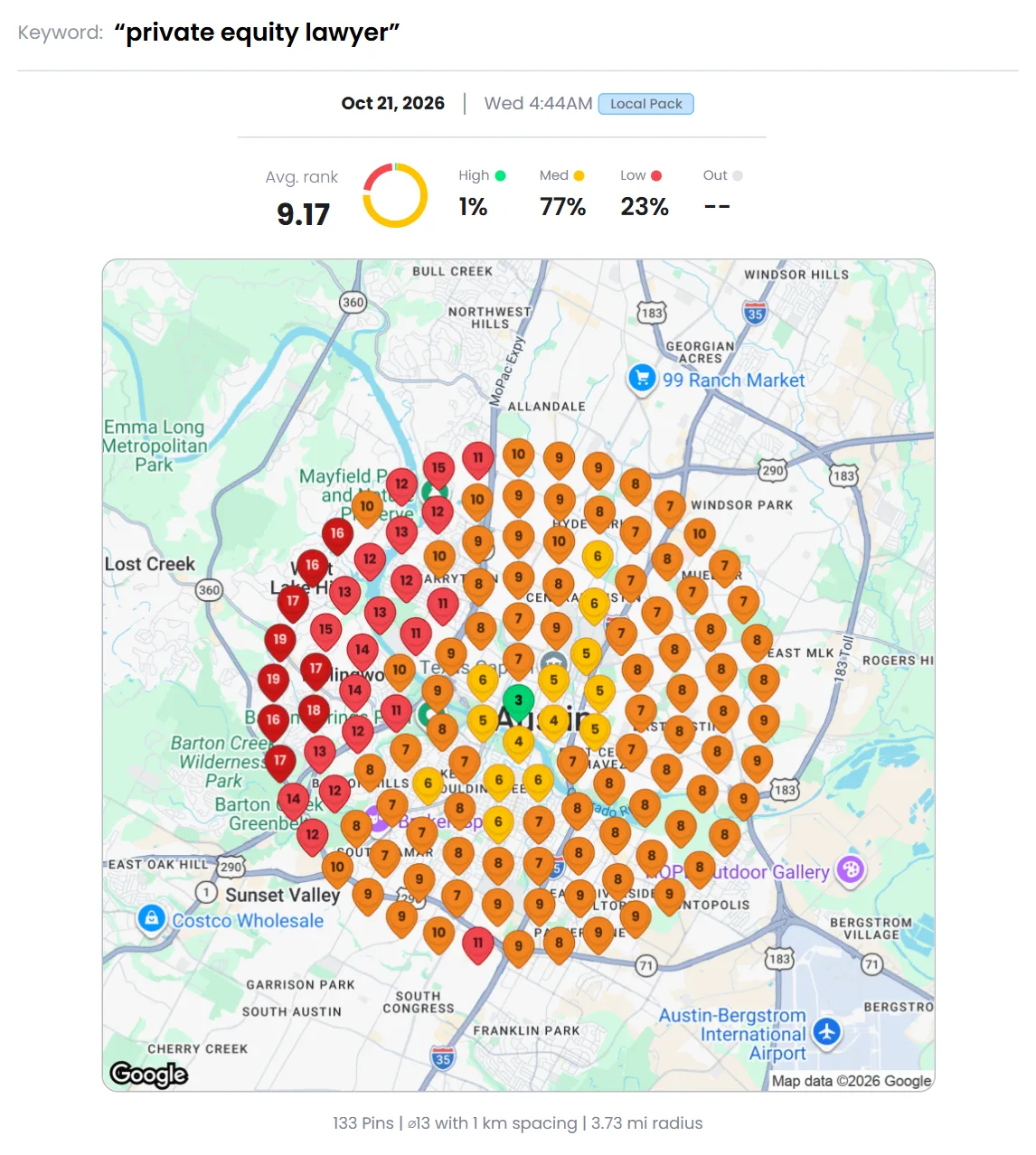
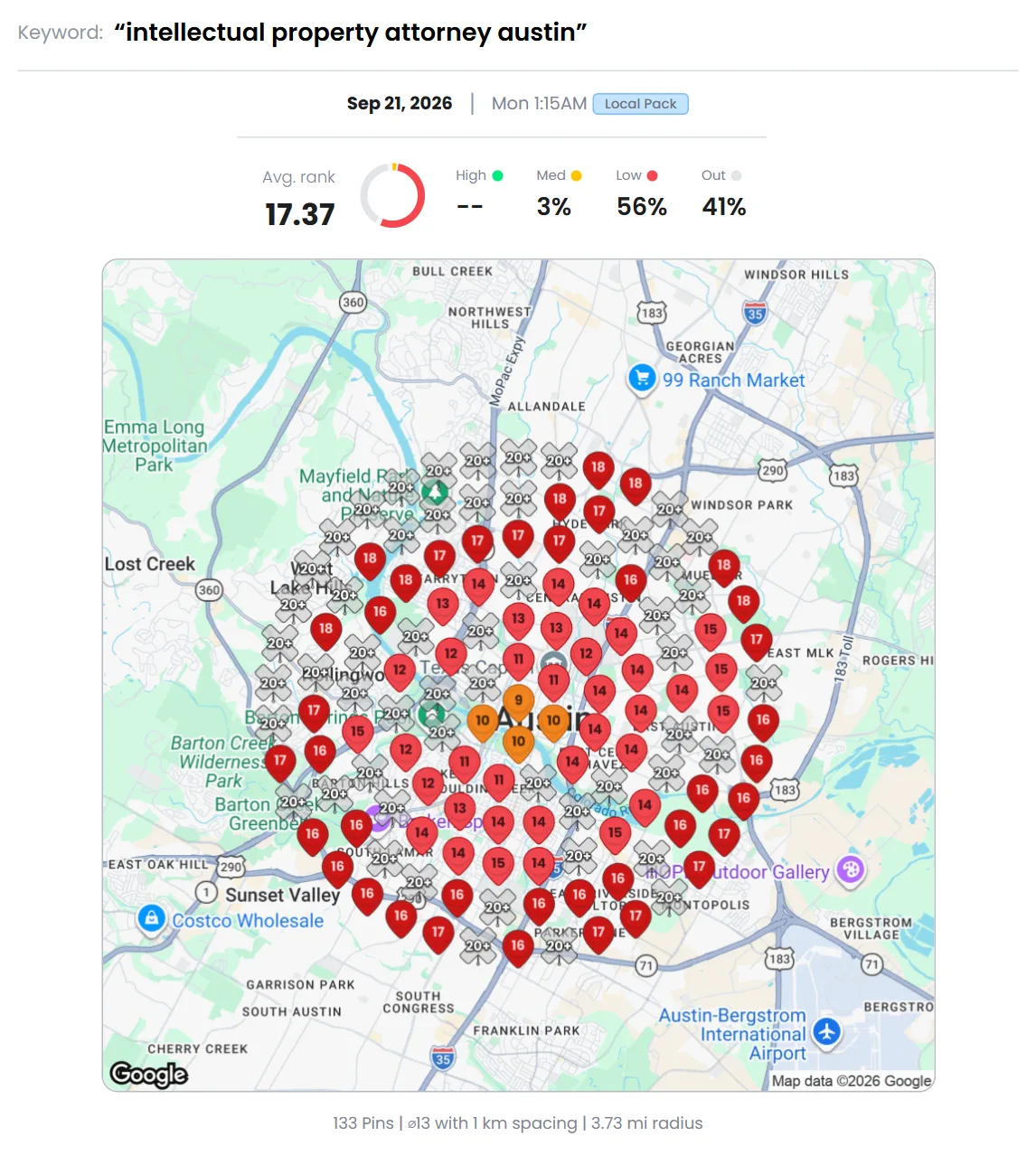
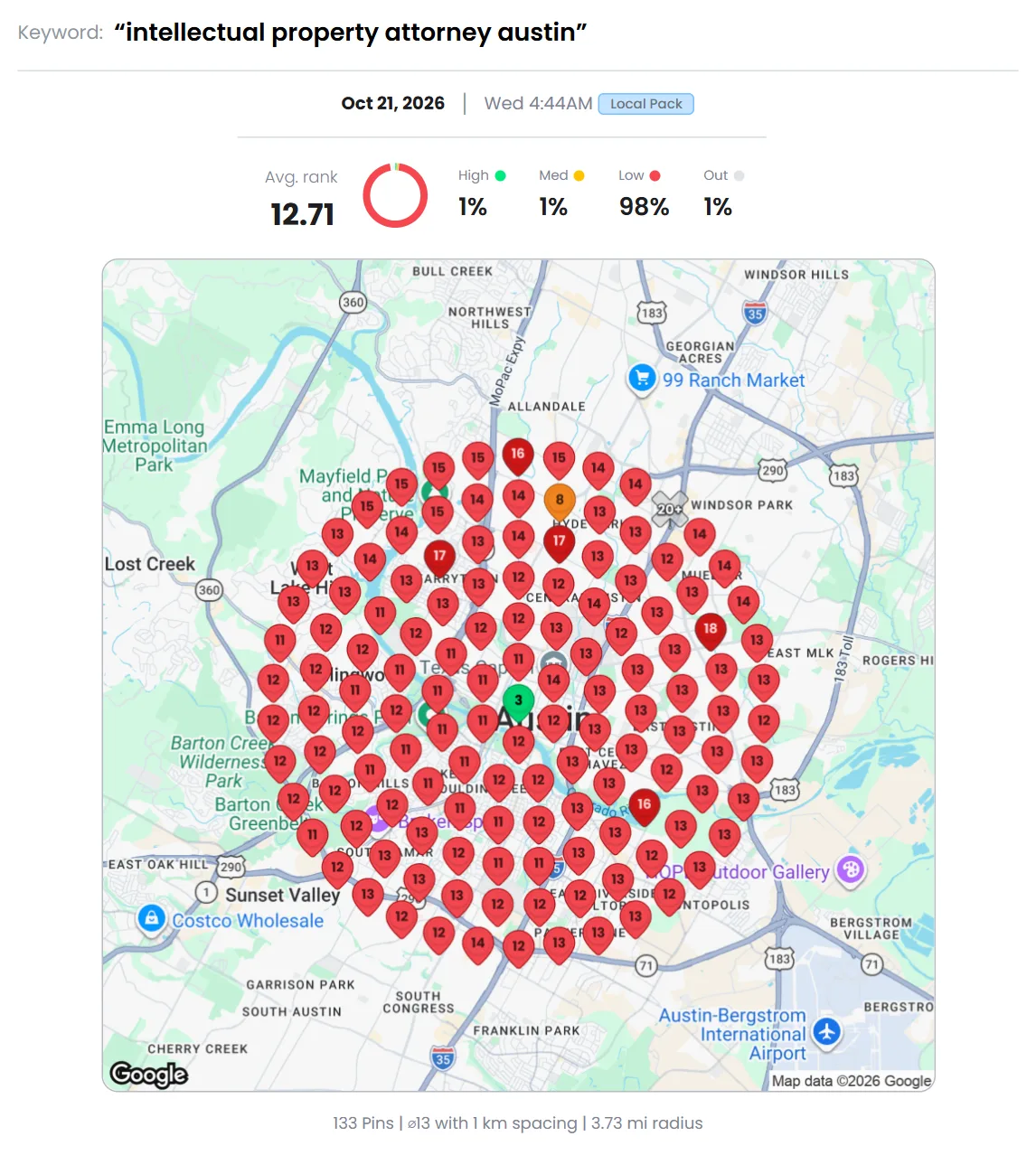
Each scan checks the firm’s Google Maps ranking from 133 points in a circle around the office: a 13-point-wide grid with 1 km spacing, reaching 3.73 miles out. Before and after scans used the same centre, the same grid and the same type of Google local results, so they can be compared directly. Lower average rank is better; points outside the top 20 count as 20.
Results: before and after
| Keyword | Average rank | Points in top 10 | Points where the firm appears (top 20) |
|---|---|---|---|
| private equity lawyer | 17.46 → 9.17 | 10 → 103 | 63 → 133 |
| intellectual property attorney austin | 17.37 → 12.71 | 4 → 2 | 79 → 132 |
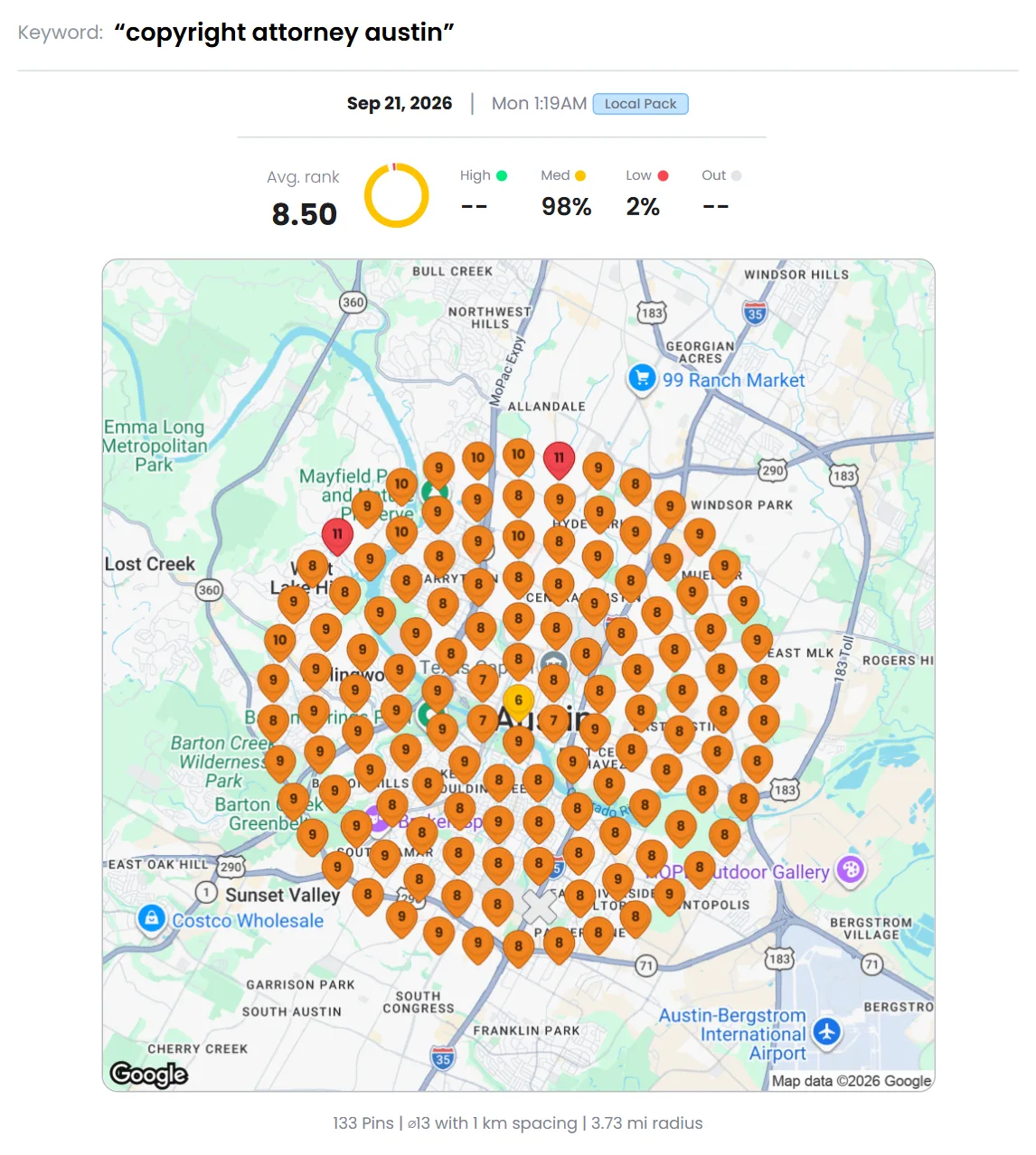
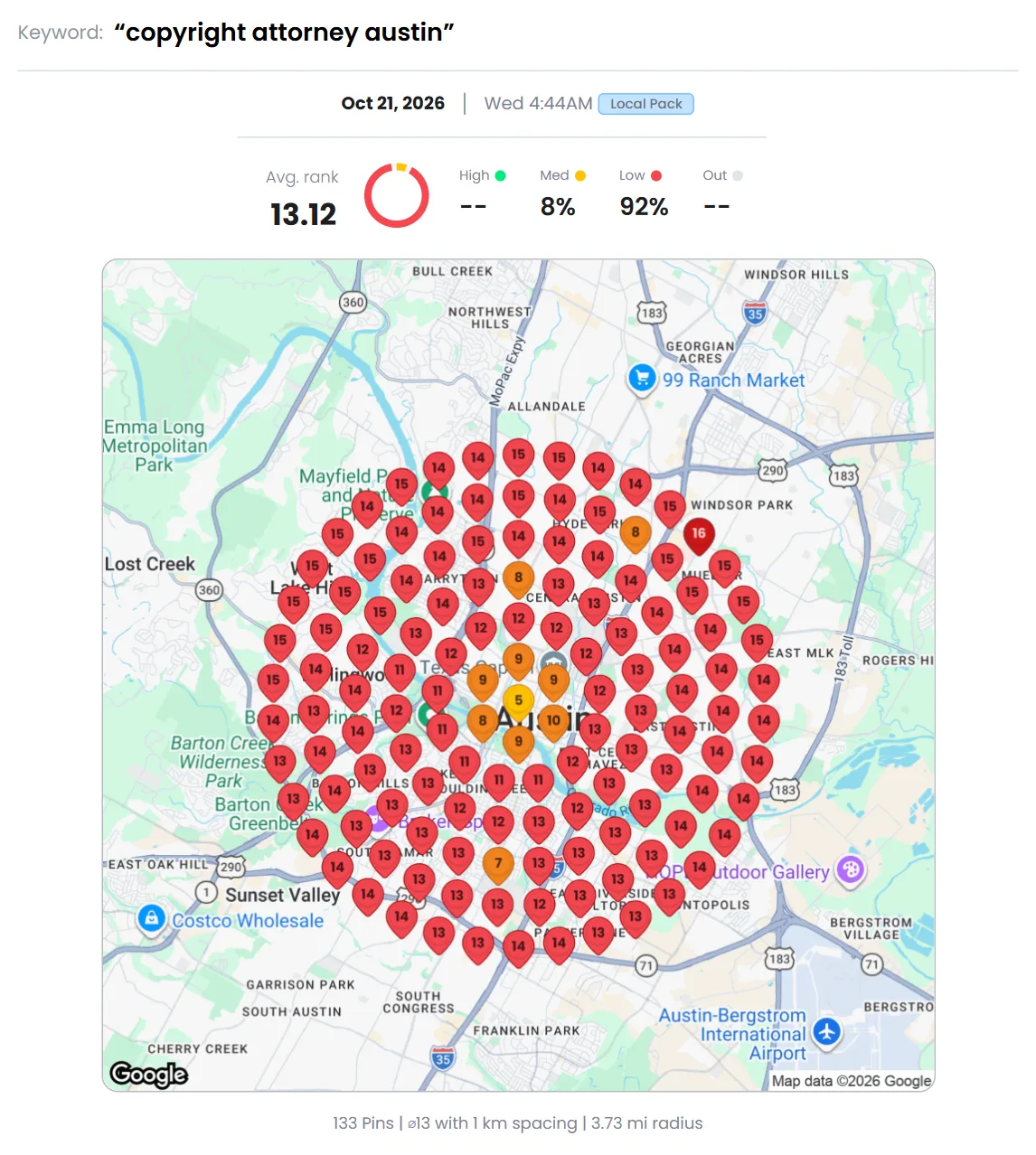
| copyright attorney austin | 8.50 → 13.12 | 130 → 10 | 132 → 133 |
Before: 21 September 2026. After: 21 October 2026. 133 grid points per scan.
“private equity lawyer”: from scattered to city-wide
This is the clearest change. Before, the firm reached the top 10 only in a small cluster downtown. After, it ranked in the top 10 at 103 of 133 points and appeared in the top 20 at every point in the grid.
“intellectual property attorney austin”: visible almost everywhere
Here the gain is coverage rather than top positions. The firm went from appearing at 79 points to 132 of 133, so its average rank improved by more than four places. Most of those points are still in positions 11 to 13, so the firm remains outside the three-place Map Pack across most of the city for this search.
Leads in October
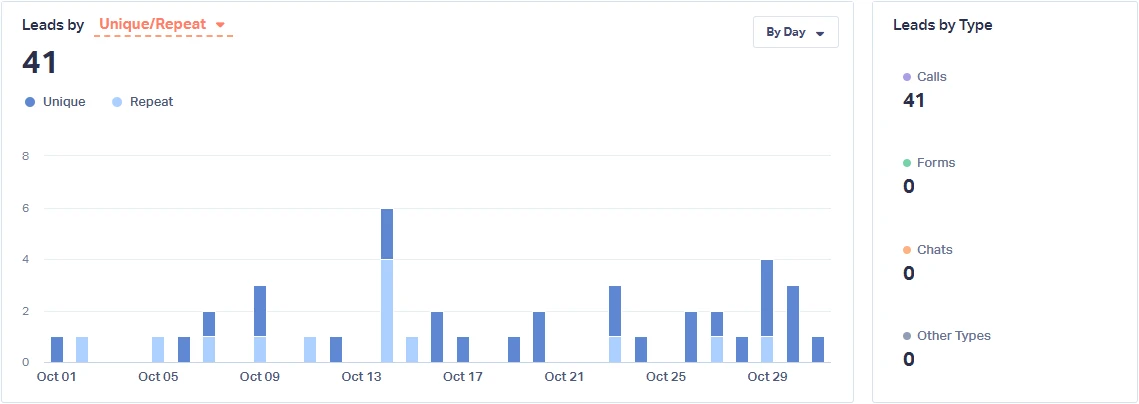
The firm tracks every enquiry with call tracking. In October 2026, the month the article went live, it received 41 tracked leads, all of them phone calls, with no form or chat enquiries. The count covers calls from all tracked sources, not only Google Maps.
What did not improve
We are publishing this one too. For “copyright attorney austin” the firm was already strong, in the top 10 at 130 points. After, it was in the top 10 at only 10 points, though it still appeared everywhere in the top 20.
Local rankings move for many reasons at once: competitors’ activity, new reviews, Google updates and the way Google weighs closely related searches. One article can strengthen some topics while related ones shift. That is why we track several keywords and report every result, not only the best one.
What we would and would not conclude
- The timing lines up. The two keywords that gained moved most in the 30 days after the article went live, and it was the only Cloud Link work published in that period.
- It is not a controlled experiment. We cannot rule out other factors, so we would not promise these numbers to another client.
- Measure the same way every time. Use the same grid, centre and scan type before and after. A Google Maps scan and a Local Finder scan are different result sets and should not be compared.
- Report the losses. Clients trust a report that shows what went down as well as what went up.
Frequently asked questions
How much did rankings change?
Over 30 days, “private equity lawyer” went from 10 to 103 of 133 grid points in the top 10, and its average rank went from 17.46 to 9.17. “intellectual property attorney austin” went from appearing at 79 points to 132. “copyright attorney austin” fell from 130 top-10 points to 10.
How many leads did the firm get?
The firm’s call tracking recorded 41 leads in October 2026, all of them phone calls, with no form or chat enquiries. The count covers calls from all tracked sources.
What exactly was published?
One Cloud Link source article of 1,491 words, hosted on Amazon S3 and published on 5 October 2026. It contains one contextual link to the firm’s website and an embedded Google Map of the office.
Did the article cause the ranking changes?
The timing lines up and no other Cloud Link work was published in the period, but this is a case study, not a controlled experiment. Competitors, reviews and Google updates also affect local rankings, and one related keyword fell during the same period.
How were rankings measured?
With saved geo-grid scans of Google local results: 133 points, 1 km apart, centred on the office, reaching 3.73 miles out. The before and after scans used the same grid, centre and result type.